


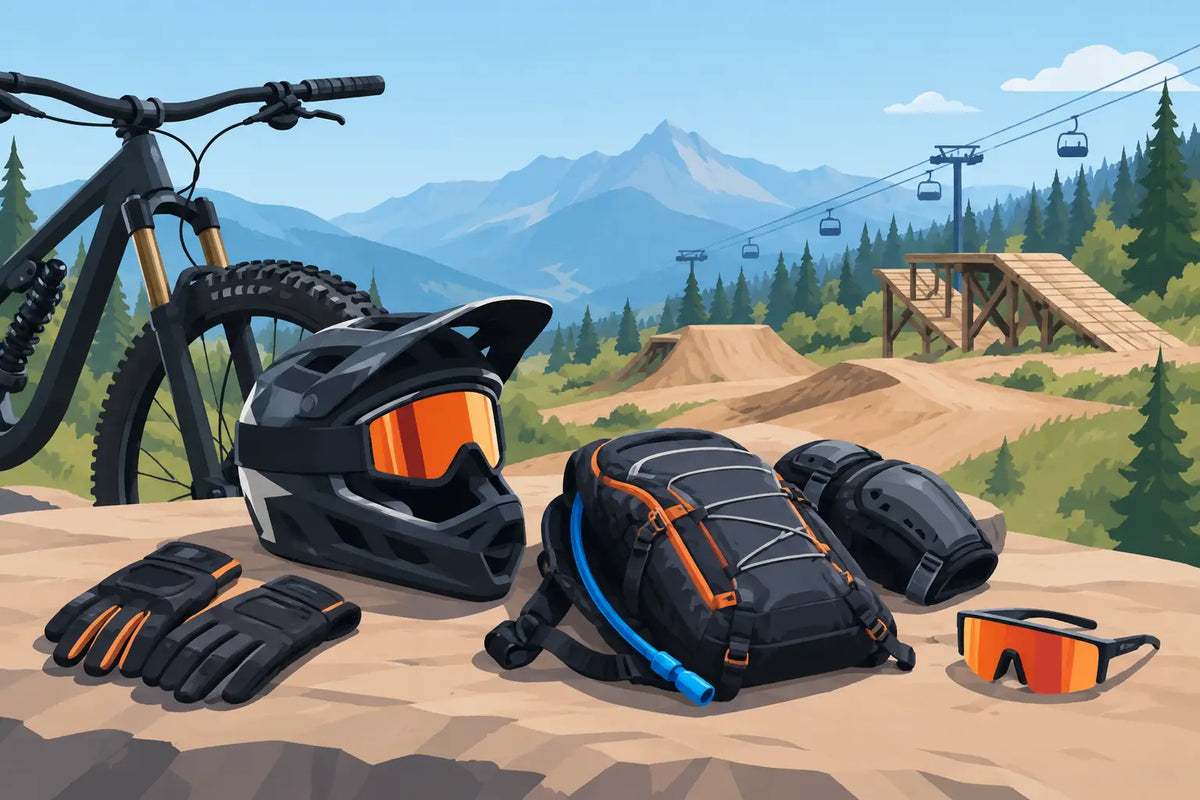
A bike park doesn't forgive inadequate gear. Between hard landings, root sections, banked turns, and repeated braking, the best bike park accessories are those that truly protect, improve control, and prevent you from ending the day in the shop with a preventable problem. The right choice depends on your skill level, the type of trails you ride, and your bike, but some items definitely deserve a place in every bag.
The best bike park accessories start with protection
In a bike park, the full face helmet It's the go-to helmet as soon as the slopes become fast, steep, or technical. It covers more of the jaw and back of the head than a classic helmet. For a day of downhill skiing in Verbier, where the slopes can alternate between flow, natural terrain, and more challenging sections, this added protection is far from negligible.
Look for a well-ventilated model, approved for downhill mountain biking, and above all, one that fits your head shape. A helmet that moves around, compresses your temples, or obstructs your vision becomes a problem after a few climbs. If you wear goggles, try them on together: the frame should fit snugly without pushing the helmet upwards.
Knee pads are the other priority. They need to absorb impact, but also stay in place while you're pedaling to the start, walking through technical sections, or doing multiple runs. For smooth blue and red trails, soft, lightweight protection may suffice. On black runs, jump lines, or wet trails, a more structured knee pad is often a better choice.
Elbow pads are more divisive. They're not essential on every easy descent, but they're especially useful when speed increases or you're working on your jumps. A fall forward, even at low speed, often results in injuries to your hands, elbows, and shoulders. Add long gloves with a durable palm: they protect your skin, improve grip, and reduce hand fatigue when the terrain gets rough.
Back protector, protective shorts and goggles: depending on your activity
A back protector is a good choice for riders who ride fast, explore challenging bike parks, or spend time on natural downhill trails. The trade-off is simple: more protection, but a little more warmth and bulk. Modern models remain flexible enough not to hinder riding, provided you choose the right size.
Protective shorts with hip and tailbone reinforcements aren't just for competition. They offer real psychological comfort to riders progressing on jumps or steep sections. They don't replace good technique, but they can allow riders to focus on their position rather than worrying about falling.
Finally, a suitable mask or goggles makes an immediate difference. On descents, dust, mud, and small stones are quickly thrown up. In changing weather conditions, a versatile lens is often more useful than a very dark one. Visibility is just as important for choosing a line as it is for reading the terrain when approaching a compression.
Bike park accessories that really improve control
The grips are your first point of contact with the bike. Worn, too thin, or too thick grips can create tension in your forearms and reduce braking precision. A pair of locking grips is easy to replace and can transform the feel of the handlebars. The ideal diameter depends on the size of your hands and how you hold the handlebars: you should be able to relax your fingers without losing control.
The flat pedals Pedals with good pins are a particularly logical investment for the bike park. They offer great freedom of foot placement and make it easier to get off the bike if you make a mistake. Clipless pedals still have their appeal for some experienced riders, especially on more challenging trails, but they require a solid foundation of practice. If you're new to jumps, banked turns, or steep descents, flat pedals can make learning much smoother.
Don't underestimate the importance of footwear. The sole should grip the lugs without being too flexible. A lightweight trail running shoe might be suitable for an occasional outing, but a dedicated mountain bike shoe generally offers more support, toe protection, and stability on landings.
A compact front mudguard is also among the most useful accessories, especially when the ground is wet. It limits spray towards the face and keeps the goggles cleaner. This is no small detail when the weather changes rapidly in the mountains or after a downpour on wooded trails.
The bike park bag: lightweight, but ready to go in a pinch.
Setting off without at least the bare minimum of repair equipment is a waste of money. A flat tire, a loose screw, or a broken chain can cut your day short. A compact bag or a mountain bike fanny pack should contain everything you need to get going again quickly, without carrying the same weight as you would for an alpine crossing.
Pack at least one inner tube that fits your wheel size, tire levers, a compact pump or CO2 cartridge, a multi-tool with a wrench for axles and main bolts, and a quick link compatible with your chain. If you're riding tubeless, also bring tire repair plugs. They can often fix a puncture in minutes, where sealant alone isn't enough.
Water and food remain essential. The bike park gives the impression of being all downhill, but the effort of braking, core engagement, and concentration adds up. A water bottle or hydration pack, supplemented with an energy bar, prevents one run too many and being performed with less focus. On a long day, fatigue rarely translates into a perfect line.
Adjustments and spare parts: where consistency is achieved
The best bike park accessories aren't limited to visible protective gear. A high-pressure pump for adjusting your fork and shock absorber deserves a place in your personal equipment. Suspension It must support the bike through compressions while maintaining grip on roots and rough braking. Too soft, and it bottoms out and throws the rider off balance. Too firm, and it bounces and tires the arms.
Tire pressure requires just as much attention. An underinflated tire gains grip but risks bottoming out on the rim or deforming under load. An overinflated tire becomes imprecise and slips more easily on roots or rocks. The correct setting depends on the rider's weight, the tire casing, the rim width, and the trail conditions. Note your tire pressures after a good day: this reference is more useful than a randomly copied value.
A spare pair of brake pads is essential for an intensive riding trip. Long descents, mud, and moisture accelerate wear. If the lever feels spongy, the brakes lose power, or you hear a metallic noise, don't wait until the last climb. A check-up at a shop is better than unreliable braking on a steep section.
Choose according to your level rather than according to the trend
The intermediate rider should first invest in a helmet, knee pads, gloves, good pedals, and a repair kit. These accessories provide immediate safety and comfort. The experienced rider, who rides frequently and seeks greater speed, can supplement this with a back protector, a high-pressure pump, reinforced tires, and more comprehensive protective gear.
Budget matters, but it's important to distinguish between aesthetics and what actually improves your ride. Properly fitted protection, consistent tire pressure, and well-maintained brakes will always have a greater impact than a trendy accessory. If you're renting a bike or exploring local trails, ask for advice before buying: at Backside Verbier, the opinion of a technician familiar with the terrain will help you avoid making unsuitable choices.
Before your next run, take five minutes to check your helmet, brakes, tires, suspension, and the contents of your bag. This small ritual leaves you with energy for what really matters: choosing your line, progressing run after run, and fully enjoying the descent.


