When the roots become shiny, the turns deepen, and the earth clings to the frame, a Mud mountain bike tire test It's not just about counting the knobs. The right tire should grip the ground without gaining traction, brake straight, and maintain precise steering when the terrain shifts beneath the wheels. In the mountains, the right tires often inspire more confidence than an improvised suspension setup at the trailhead.
Mud tires are a specialized tool. They rarely offer the performance of a fast tire on dry surfaces, nor the comfort of a very wide, supple-casing tire. Their natural habitat is soggy undergrowth, loose soil, greasy tracks, and days when the weather transforms a typical ride into a technical challenge. A well-chosen mud tire allows for a more relaxed ride. A poorly chosen one can feel like riding on soap, even with good technique.
What a mud tire needs to achieve on the terrain
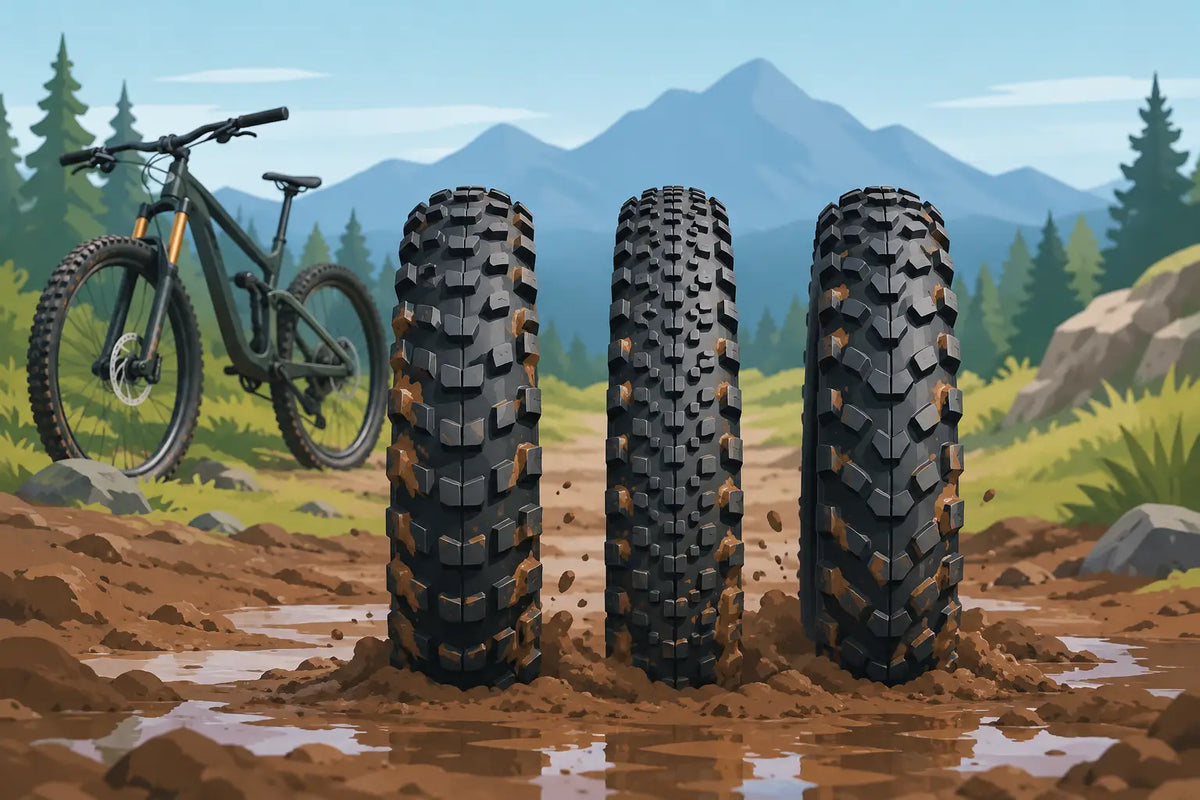
A tire designed for mud is first and foremost recognizable by its tall, widely spaced knobs. This geometry sheds mud with each rotation: this is called mud shedding. If the knobs are too close together, the tire fills up, becomes slick, and quickly loses all its effectiveness. On a wet climb or a traverse across a slope, the difference is noticeable within just a few meters.
Height alone isn't enough. The side knobs must grip when the bike is leaned over. They're what secure the entry into corners and provide a clear foothold on wet roots. Well-placed center knobs, on the other hand, influence traction and braking. A good tread pattern, therefore, maintains a balance between traction, water evacuation, and braking stability.
The rubber compound is just as important as the tread pattern. A softer compound conforms better to a root or a wet rock, resulting in a significant gain in grip. However, it wears out faster on hard surfaces, forest roads, and dry tracks. For aggressive enduro riding or very muddy conditions, this compromise is often acceptable. For everyday riding on mixed terrain, it's worth considering.
Finally, the tire casing must match your speed, weight, and the terrain. A lightweight casing offers comfort and flexibility, but may lack support under heavy load. A reinforced casing stabilizes the tire, provides better cut protection, and allows for lower pressure. It also adds weight and a less responsive feel at lower speeds.
Mud mountain bike tire test: the criteria that really matter
Testing a tire in mud requires observing its performance when grip isn't perfect, not just during a successful run. The first criterion is low-speed traction. On a steep incline, the rear tire should grip without slipping abruptly. A slight, controlled slippage is normal. A wheel that spins freely as soon as the ground is wet is not.
The second criterion is front-end precision. On a slippery surface, a tire can brake effectively while providing vague steering. Look for predictable handling: the front end should maintain traction, provide warning before losing grip, and regain traction smoothly. On the natural trails of the Val de Bagnes, this progressiveness is invaluable when loose soil alternates with slabs, roots, and compacted areas.
Braking performance is most crucial on uneven terrain. A tire that locks up instantly forces you to release the lever and increases braking distances. A good mud tire maintains grip while remaining adaptable. It allows for late braking, but more importantly, for calm braking with both the front and rear wheels under control.
Also, consider how quickly the tire clears itself after several passes. An efficient model will clean itself relatively quickly as soon as the ground becomes a little less sticky. Conversely, a tire loaded with mud loses volume, weighs down the wheels, and makes every step a gamble. This capacity varies with the type of soil: compact clay mud much more so than light, wet, black soil.
Front or rear: should you fit two mud tires?
The answer depends on the intensity of the conditions and your riding style. When the terrain is truly muddy, fitting a mud tire on the front is almost always the best choice. It dictates the trajectory. An aggressive tread pattern on the front provides braking and better feedback from the road, two qualities that help you ride aggressively without being overwhelmed by every turn.
At the rear, the choice can be more nuanced. Two mud tires offer maximum traction and consistency in very poor conditions. This is ideal for a rainy day, a race, an enduro ride on loose terrain, or tracks that remain waterlogged. On the other hand, on a route alternating between wet forest and firm sections, a medium rear tire can roll better while maintaining sufficient traction.
A mixed setup is often the most practical for riders who don't want to change tires after every downpour: a mud tire on the front, an aggressive all-rounder on the rear. You lose a little grip on the muddiest climbs, but you gain in efficiency and tire life. There's no one-size-fits-all setup, only a compromise tailored to your ride.
Width, pressure and inserts: the assembly makes all the difference
A mud tire that's too wide can float on very soft ground instead of driving through it. In deep mud, a slightly narrower section sometimes helps the treads reach a more consistent layer of soil. Conversely, on wet roots and smooth rocks, a wider section provides comfort and a useful contact patch. For many modern bikes, a width of around 2.4 to 2.5 inches remains a good starting point, to be adjusted according to the rim and frame.
Tire pressure is the quickest way to change a tire's behavior. Too inflated, and the tire will bounce off roots and slip without deforming. Too low, and it will become imprecise in corners, can twist on the rim, and increase the risk of pinch flats. Start with a pressure slightly lower than your usual dry setting, then adjust it gradually.
The rider's weight, the type of casing, the tire volume, and the presence of an insert completely change the ideal value. With an insertYou can generally ride a little lower while still maintaining support and better rim protection. But an insert doesn't replace a suitable casing: on a fast, rough descent, lateral support remains essential.
The trap of the mud tire used for too long
Mud tires can become a disadvantage as soon as the ground dries. Their high treads deform more easily on slabs, tight corners, and fast trails. The bike may feel less precise in corners, noisier, and slower to pedal. Wear also accelerates, especially on the rear tire.
This isn't a reason to avoid this type of tire. It's a reason to use it at the right time. If the forecast predicts several wet days, if the trails remain cold and shaded, or if your riding plan favors natural tracks, a mud tire is perfectly suited. If the ground dries on the surface by midday, an aggressive intermediate tire will sometimes be more appropriate.
The other mistake is believing that the tires will solve everything. A low position on the bike, progressive braking, and looking ahead remain essential. In mud, seeking traction rather than fighting the bike is often the best technique: relax your arms, let the bike move slightly, and load the tires gently.
When to ask for advice at the workshop
The choice becomes more complicated if your bike has limited clearance around the tire, if your rim is very wide, or if you're hesitating between several casings. A tire that bunches up in a narrow frame can lock the wheel or damage the paintwork with stones and dirt. You should also check the condition of the sealant. tubeless sealing and the actual wear on the cleats before going riding in the rain.
In Verbier, the Backside team can help you to choose a consistent mount With your bike, your skill level, and the current conditions, then adjust the pressure and check the assembly. This is especially useful before a wet weekend or a guided ride where the goal is to ride, not spend the morning repairing.
The right question isn't simply "which tire grips best in mud?" Instead, ask yourself what kind of terrain you'll be riding on, at what speed, and with what level of commitment. The ideal tire is one that allows you to maintain precision when the trail deteriorates, and then leave you wanting to go again, even in the rain.