


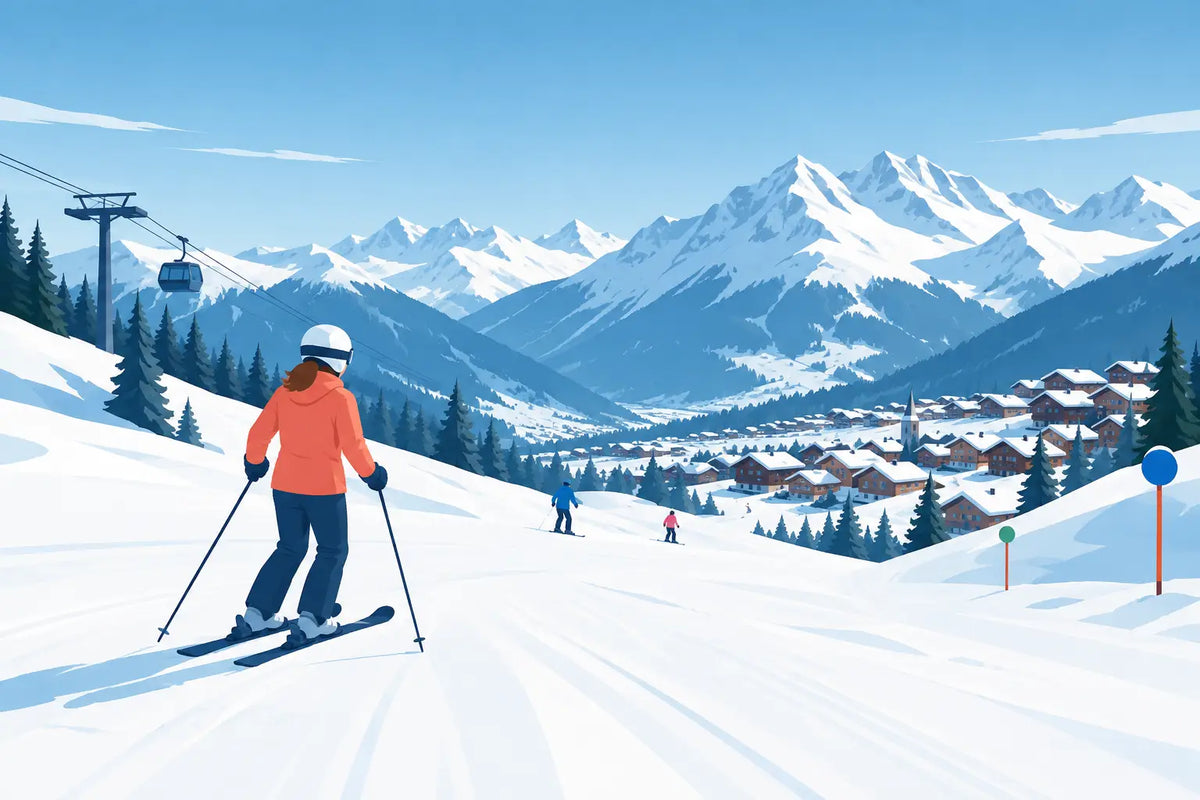
The first turn isn't on a legendary track, but on a slope where you can stop, start again, and repeat without pressure. If you're looking for where to ski for beginners in VerbierDon't immediately aim for the highest area or the long descents that the resort is famous for. Start in the areas designed for setting up the base, then gradually expand your playground.
Verbier is often associated with steep vertical drops, freeriding, and sporty skiing. This is true, but the resort also offers good options for learning, provided you choose the right starting point and don't confuse an accessible blue run with a truly comfortable one for a first day.
Where to ski as a beginner in Verbier: Les Esserts is the priority
For an adult discovering skiing, a child, or a family wanting to ease back into it, the Esserts sector is the most logical choice. Located above the village, it offers a quieter environment than the main ski areas. The slopes are gentle, wide, and easy to follow, with a natural progression from the learning area to the easier runs.
This is where you work on what really matters at the beginning: finding your balance, gliding across slopes, mastering the snowplow turn, turning in both directions, and stopping without panicking. On a moderate slope, these movements quickly become more intuitive. On a steeper slope, the body tenses up and learning slows down.
Les Esserts also has a very practical advantage: it's easy to take breaks and return to the starting point. For a first day, this simplicity avoids wasting time on lifts, transfers, or long connecting sections. Accompanying persons can stay close, which reassures both children and adults unfamiliar with the mountains.
The morning is often the best time to go. The snow is generally more consistent, your legs are fresh, and it's less crowded. When the sun transforms the snow at the end of the day, a slope that was easy can become more challenging for a beginner, especially if it's very busy.
Moving from the first turns to the blue runs
When your stops are controlled and your turns flow smoothly without constantly looking at your skis, it's time to try an easy blue run. The right moment isn't measured by the number of hours spent on skis. It's recognized by the ability to control your speed, look far ahead, and get up on your own after a fall.
Don't rely solely on the color of the trail. A blue run might be smooth and ideal, or it could have a narrower section, a steeper section, or bumps depending on the snow conditions. Before heading out, observe the start of the trail, ask a professional for advice, and identify safe stopping points on the side.
In Verbier, the route you choose also depends on your goal. To learn, it's better to ski a short run three times than to ski down a long run with your legs seized up. Repetition builds confidence. Distance alone proves nothing.
Savoleyres and La Tzoumaz: the logical next step depending on your level
Once the fundamentals are mastered, the Savoleyres sector offers excellent progression. Its atmosphere is often more relaxed than the heart of the ski area linked to the peaks, and some of its slopes are well-suited to beginner skiers who can already turn smoothly. It's a good stepping stone to discovering more vertical drop without immediately venturing into overly challenging terrain.
La Tzoumaz, linked to the ski area, is also worth considering for its family-friendly atmosphere and often more accessible slopes. It can suit an independent beginner or a family with varying skill levels. More experienced skiers will find plenty of variety, while beginners can stick to suitable runs.
The downside of this progression is simple: the further you start from the learning area, the more planning is required for the return. Check the time of the last lift, which runs are open, and your return route before leaving the area where you feel comfortable. Afternoon fatigue can turn an easy run into a bad experience.
Should you go up to Les Ruinettes when you're a beginner?
Les Ruinettes naturally appeals: altitude, panoramic views, and access to the vast ski area. But it's not necessarily the best first destination. For a true beginner, the advantages of a higher ascent must be weighed against the slopes they'll then have to ski, the crowds, and the connections they'll need to navigate.
If you've already mastered the basics on gentle slopes, a guided outing or specific advice on the day's trails can make this new experience worthwhile. However, if braking remains unpredictable or if every slightly steep section causes you to freeze up, stick to the lower sections. This isn't a step backward; it's choosing the terrain that will help you progress the fastest.
Conditions vary considerably between the village and higher altitudes. Flat visibility, wind, hard snow in the morning or heavy snow in the afternoon significantly alter the difficulty. Always check the day's openings and adapt your itinerary rather than following a plan made the day before.
Materials that make learning easier
A good slope can't compensate for boots that are too big, skis that are too long, or poorly adjusted bindings. For beginners, choose a forgiving piste ski that's easy to turn, and a length that suits your height, weight, and actual skill level. Your equipment should help you initiate turns, not force you to fight them.
Shoes are the most important factor. They must support the heel without causing pain or restricting circulation. A slight firmness is normal, but numb toes or sharp pain are not. Report any discomfort immediately when trying them on: a simple adjustment can make all-day difference.
For a first rentalClearly explain your experience, even if you skied ten years ago. Memories often come back, but equipment, physical condition, and any apprehension on the first day matter more than recalling a distant trip. At Backside Verbier, the value of local advice lies precisely in adapting your equipment to the terrain you'll actually be skiing on, not to some idealized image of your skill level.
A helmet is essential, especially in learning areas where trajectories can be unpredictable. Add a weather-appropriate mask, warm gloves, and an easily removable mid-layer. Being too hot is just as tiring as being too cold.
A well-structured beginner's day
A course This is the fastest way to develop good habits. An instructor immediately corrects your posture, gaze, and weight transfer. They also choose exercises and inclines that are appropriate for when you're practicing them. For an adult, a few hours of instruction at the beginning often saves several days of repeating an ineffective movement.
Without lessons, set yourself a modest and specific goal. For example: successfully stop at a chosen point, link five smooth turns, or descend the same slope at a constant speed. Don't try to keep up with a more experienced friend or family member on a slope that's beyond your abilities. The skill level of a group should be that of the least confident person.
Also, take short but regular breaks. Skiing puts a strain on your thighs, ankles, and concentration. When your legs burn, your stance deteriorates and falls become more likely. Stopping before you're exhausted is a technical decision, not giving up.
Before you leave, check these four points:
- the lifts and slopes open in the chosen area;
- the weather, especially wind and visibility;
- the latest return time if you change sides;
- the adjustment of your shoes, of your fixings and your helmet.
Mistakes that complicate beginnings
The first mistake is choosing a run simply because it's marked blue, without considering its profile. The second is trying to maximize your lift pass by skiing for too long. A well-executed half-day is far better than a full day spent struggling to survive on the slopes.
Also, avoid skiing in the middle of the piste when you need to stop. Move to the edge, to a visible spot, without stopping under a drop or behind a turn. Quickly learn to look uphill before setting off again. These reflexes are part of skiing from day one.
Finally, don't confuse speed with progress. The skier who truly moves forward is the one who maintains balance, chooses their line, and can slow down at any moment. In Verbier, the great routes will still be there tomorrow. Take the time to perfect your first turns, and the ski area will naturally open up to you.


